What to expect at Phoebe Bridgers' The Lost Tour: Setlist, start time, no-phone policy and more
Sep 29, 2026
·Annmarie Gajdos
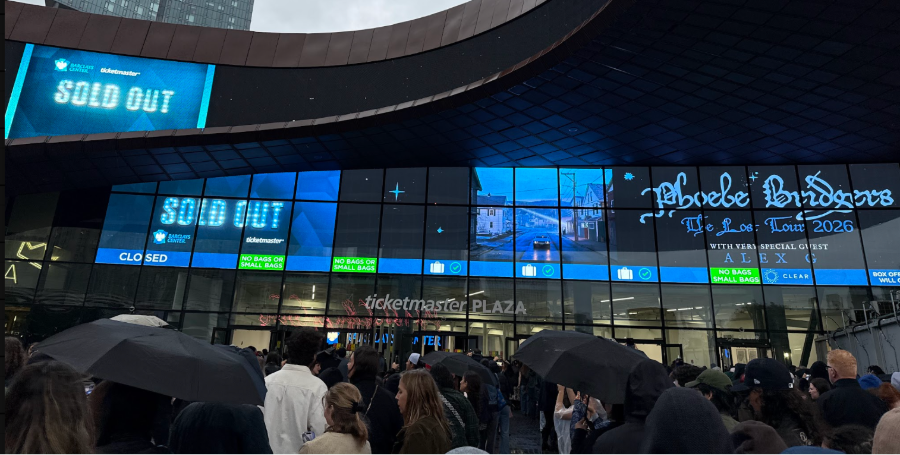
Welcome to SeatGeek Front Row, where music writers share their tips for attending the biggest concert tours around the country. For this edition, NYC concert expert Annmarie Gajdos breaks down what it’s really like to see Phoebe Bridgers' "The Lost Tour" in person, from the setlist to experiencing a concert without a phone.
I went to the third and final night of Phoebe Bridgers’ sold-out Barclays Center run in Brooklyn on Sept. 26, and I’ll admit I walked in expecting one part of the experience to drive me crazy: The Lost Tour is completely phone-free.
I capture live events for a living, so concerts usually come with an internal debate. Do I record this song? Am I filming too much? Should I put my phone away? Will I regret not getting that moment later? Somehow, no matter which option I choose, there’s always a little part of me left wondering whether I chose wrong.
At Phoebe Bridgers, there was no choice.
My phone, Meta Ray-Ban glasses and every other electronic device I brought were locked inside a Yondr pouch before I entered the arena. And against basically every expectation I had, I loved it.
What a Phoebe Bridgers Lost Tour concert is really like
I arrived not knowing a single Phoebe Bridgers song. By the time I left, I had cried, danced, watched thousands of people move together without a phone screen in sight and experienced one of the most unique concerts I’ve attended in a long time.
Here’s what you should know before seeing Phoebe Bridgers on The Lost Tour.
Who opens for Phoebe Bridgers?
Alex G opened the Barclays Center shows and is supporting the North American leg of The Lost Tour.
His set ran from approximately 7:30 to 8:30 p.m. at Barclays and took place entirely on the circular B-stage.
The production was comparatively simple: minimal lighting, a ring of vertical fixtures around the stage and much less spectacle than Phoebe’s set. It started slowly before gaining energy as it progressed, and the crowd was clearly familiar with his music.
Alex G and Bridgers also collaborate on “Lost Boys,” which Phoebe performed during her own set later that night.
One thing worth knowing: a significant portion of the crowd was still stuck in merch lines during Alex G. Around three songs into his set, I noticed the arena filling considerably as people finally began leaving the concourse and finding their seats.
What songs does Phoebe Bridgers play on The Lost Tour?
Phoebe’s Sept. 26 Barclays show started on the main stage with “The Outside,” followed by “Motion Sickness,” “Kill Me,” “The Governor’s Waltz” and “Lost Boys.” She later moved to the B-stage for a slower section that included “Lost Weekend,” “Funeral,” “Graceland Too,” “Haunted,” “Still Standing” and “As Above.”
The pacing felt unusually natural. There wasn’t a point where I felt like the show suddenly slammed on the brakes or jumped awkwardly between moods. The B-stage section was noticeably quieter and more intimate, but it felt like a deliberate change in energy rather than a lull.
When Phoebe returned to the main stage, one of my favorite unscripted moments happened during “Bobby.” She realized she had gotten the lyrics wrong, stopped, admitted she had messed up the song and asked the audience whether they wanted to hear it again.
They did.
So she restarted it.
Later came the night's biggest surprise.
Julien Baker and Lucy Dacus joined Phoebe onstage for a boygenius reunion, performing “Not Strong Enough” before the trio played “Powers,” which marked its tour debut. The arena exploded.
That section was followed by “Kyoto” and the cathartic chaos of “I Know the End.”
Main stage
The Outside
Motion Sickness
Kill Me
The Governor’s Waltz
Lost Boys
DVD Menu
Garden Song
Moon Song
Liberty Tree
B-stage 10. Panorama (instrumental) 11. Lost Weekend 12. Funeral 13. Graceland Too 14. Haunted 15. Still Standing 16. As Above
Back to main stage 17. Bobby [she sang the wrong lyrics during the second verse, then restarted the song] 18. Georgia 19. I Can’t Wait 20. On Video 21. Not Strong Enough [with boygenius] 22. Powers [with boygenius; tour debut] 23. Kyoto 24. I Know the End
Encore 25. Lost Weekend (Reprise) 26. Scott Street 27. Never Going Back! (band only)
What does Phoebe Bridgers’ Lost Tour stage look like?
The best description I can give is sad-girl music transported into a strange celestial universe.
The main stage was dominated by a large dome-like UFO structure that, to me, looked inexplicably like the igloo-style outfit from The Lizzie McGuire Movie. Behind it, curtains became massive projection surfaces for stars, constellations, glowing skies and psychedelic colors.
Before Phoebe even appeared, a glowing orb hovered above the B-stage and slowly began rising. It felt a little like waiting for an alien abduction.
Then the main-stage structure lifted and Phoebe appeared.
Throughout the show, smoke poured around the UFO, lasers cut through the arena and celestial imagery shimmered across the curtains. At various points, orange suns and moons appeared, stars covered the background and green beams descended around the circular B-stage until Phoebe genuinely looked like she was being beamed upward.
The production was elaborate without overpowering the music.
Phoebe also uses dynamics extremely well in an arena. She could get incredibly quiet before suddenly pushing her vocals or releasing a scream, with the lighting, bass and visuals expanding around those moments. The bass was heavy without swallowing the vocals, and even from Section 22, everything sounded clear and balanced.
I’m not convinced that intimacy would translate quite the same way in a stadium, but inside Barclays, it worked.
What is the B-stage like?
About six songs into Phoebe’s set, the lights dimmed and she reappeared through an entrance on the floor before making her way onto the circular B-stage.
The entire mood changed.
The B-stage sat surprisingly far back in the arena, which means seats opposite the main stage aren't a bad option for this tour. From Section 22, Row 10, my seat was almost directly in front of it.
Green beams of light engulfed Phoebe during parts of this section, almost as if she was being abducted by aliens. At another point, glitter fell from the sky.
The floor itself was divided into two separate pit areas, with a smaller section closer to the main stage and another surrounding the B-stage. Metal barriers kept the areas separated.
Despite how packed the floor eventually became, it never looked particularly chaotic. People weren't moshing; they were singing, dancing and moving together.
When Phoebe eventually made her way back toward the main stage, she walked around the pit touching fans’ hands seemingly everywhere she could reach. It wasn't a quick pass down one barricade. She made a point of connecting with people along the route, which made an already intimate section of an arena show feel even smaller.
What is a Phoebe Bridgers concert like without phones?
This was the question I had before the show, and it ended up being my favorite part of the experience.
I expected a phone-free crowd to be much more social before the show. That wasn’t really the case. Most people came with friends, partners or groups and talked to the people they already knew. As someone who attended alone, I wasn’t suddenly making 20 new friends because Instagram was unavailable.
What changed instead was my awareness of the room.
An arena is surprisingly dark without thousands of glowing screens. Once the house lights dropped, most of the light really did come from Phoebe’s stage. You could sense people getting excited. You noticed the screaming, conversations, outfits and movement around you because there wasn’t another source of stimulation sitting in your hand.
I found myself much more present.
Normally, if something visually beautiful happens at a concert, my instinct is immediately: Do I record this? At this show, there was nothing to decide. I couldn't film it, so I watched it.
That brought an unexpected amount of freedom.
Would I personally want every concert I attend to be phone-free? No. If I spent hundreds of dollars seeing one of my favorite artists, there are memories I would probably want to capture.
But I went into this particular concert genuinely thinking I might hate not having access to my phone. Instead, there was something raw and strangely peaceful about standing in a room where thousands of people were simply singing and dancing.
Phoebe had already been experimenting with phone-free shows before The Lost Tour. Her June Madison Square Garden show, where tickets cost $1 and benefited an immigration bond fund, also required Yondr pouches, and the policy was subsequently extended across the tour.
During the Barclays show, Phoebe offered a more personal explanation herself. She told the audience that after a difficult period in her life that included losing her father and suddenly receiving an overwhelming amount of attention, she wanted to return to performing music in a way she could actually enjoy. She acknowledged that locking away everyone’s phones was annoying and thanked the crowd for doing it.
Watching her perform afterward made the policy make more sense.
Would she feel quite as comfortable being vulnerable, messing up, screaming, crying, smiling and telling personal stories if thousands of cameras were pointed toward her? I can't answer that for her. But it did feel as though the absence of phones created a room where artist and audience could experience something without immediately thinking about how it would look online afterward.
How does the phone-free policy actually work?
The phone policy is no joke.
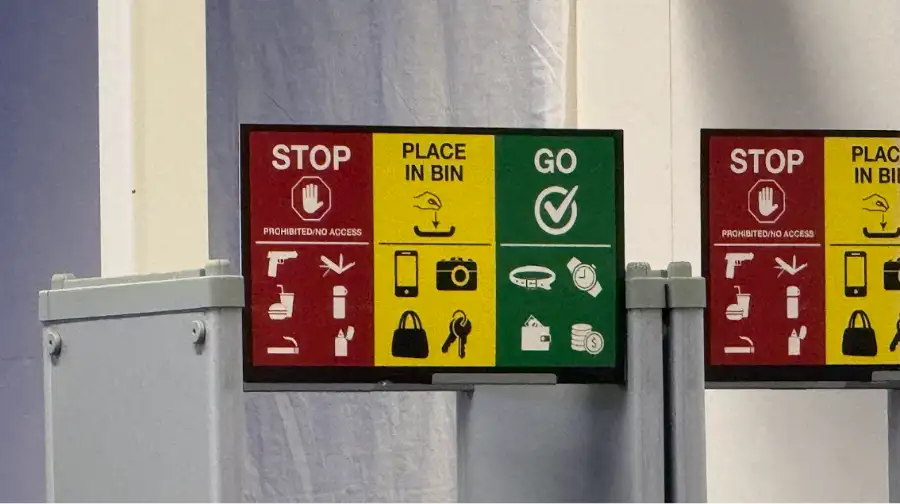
The Lost Tour uses Yondr pouches, so you keep your phone physically with you, but it is locked inside a pouch throughout the performance. The policy also prohibits smartwatches, cameras, tablets, laptops, Bluetooth headphones, Meta smart glasses and other recording devices. Designated areas were available for guests who needed to access their phones during the event, such as those with disabilities who needed to take medicine at a certain time.
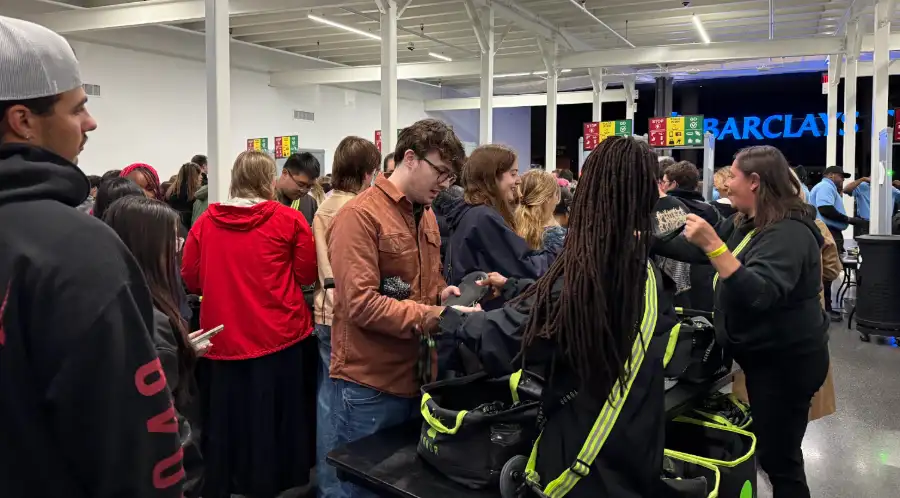
When I entered, staff asked whether I had any additional electronics. I mentioned my Meta glasses, and they went into a second pouch. The employee helping me actually told me it was good that I mentioned them because security would have sent me back if they spotted them later.
My advice: leave unnecessary electronics at home.
Also, bring a physical credit or debit card. Barclays specifically told attendees not to rely on Apple Pay, Google Pay or smartwatch payments because those devices would be inaccessible.
And perhaps my biggest tip: bring an old-fashioned watch.
You don’t realize how often you check your phone simply to see the time until you suddenly can’t. I spoke with other fans who felt similarly. Nobody I talked to seemed particularly bothered by spending the concert without their phone, but knowing the time was one thing people missed.
What happens to your phone when the concert ends?
This is another part of the Yondr experience that is worth planning for.
Once the concert ended, thousands of people immediately headed toward the exits; but everyone still needed their pouch unlocked.
Staff were stationed at multiple locations with unlocking devices. Some stations were inside Barclays, while the main entrance forced guests fully outside before reaching the unlocking line.
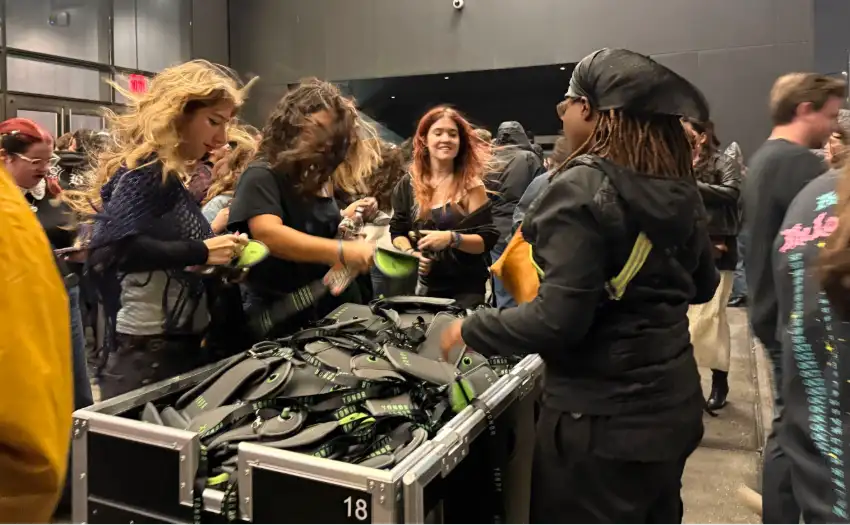
Once I actually reached an employee, the process was fast. They unlocked my pouch, made sure I removed everything and directed me to drop the empty pouch into a large collection bin.
The problem was simply the number of people trying to do the same thing simultaneously.
On my night, a nor'easter also meant everyone was trying to get outside, retrieve their phones and move through heavy rain at once. I checked the time the second I finally had my phone again: 11 p.m. exactly.
What to know before you go to Phoebe Bridgers’ Lost Tour
Besides your phone being locked away, there are a few other things worth knowing before you settle in for the night.
What time should I arrive for Phoebe Bridgers?
For the Barclays Center shows, doors opened at 6 p.m., Alex G started promptly at 7:30 p.m., and Phoebe took the stage at 9 p.m. On Sept. 26, her set ran until approximately 10:50 p.m.
Give yourself more time than you normally would to enter.
I arrived around 6:15 p.m., and getting through the combination of ticketing, security and the Yondr process took me roughly 20 minutes. Your digital ticket is scanned before your phone disappears, and I was given a small printed ticket with my seat information so I could still find my section without accessing my phone.
Barclays itself warned guests to allow additional time for entry because every phone, smartwatch and recording device had to be secured before entering.
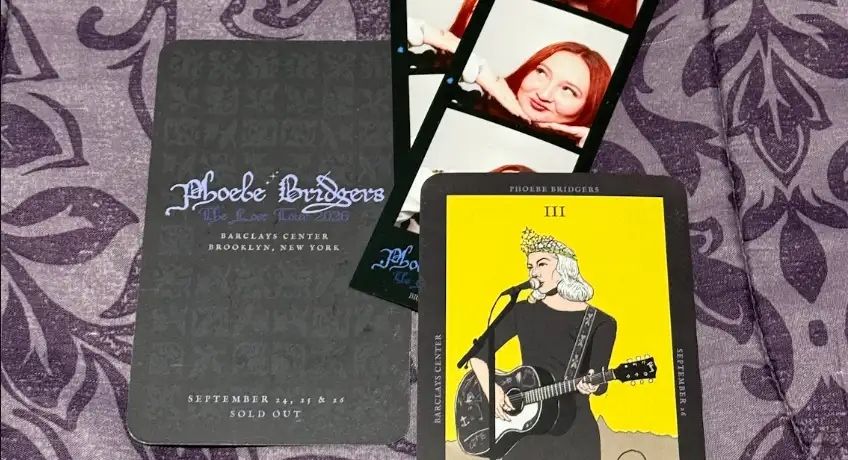
There was another reason I was glad I arrived early: free Phoebe Bridgers tarot cards.
For night three, exclusive cards were available on tables near Sections 4, 15, 19 and 25. There were three designs: The Chariot, which showed a figure being beamed up by a UFO; The Empress, featuring Phoebe with her guitar and a crown; and The Star, featuring a ghost. Each was branded with Phoebe Bridgers, Barclays Center, the three Brooklyn dates and “sold out.”
They were one of the coolest free concert keepsakes I’ve seen, but supplies went quickly. Each night had three different cards so fans who attended all three dates were able to amass quite the collection.
The cards were exclusive to Barclays Center dates but it is anticipated that future stops will have their own freebies.
What do people wear to a Lost Tour concert?
Phoebe kept the same look throughout the night: a black lace dress that fell just below her knees.
There wasn’t a costume change, which fit a show that felt much more interested in building one continuous world than creating separate moments throughout the night.
Her glitter-like tear makeup became part of the production itself. During the encore, the tears illuminated under the arena’s black light, adding another slightly surreal detail to the final moments of the concert.
Fans seemed to dress within that same universe without following one strict dress code.
I spotted skeletons and rib-cage designs, UFO and alien references, elf-like ears and plenty of flowy skirts and bohemian looks. It felt less like everyone had received the same Pinterest mood board and more like everyone had interpreted Phoebe's strange celestial world in a similar manner.
Friendship bracelets were common, too. I left with bracelets reading “sad girl” and “lost boy.”
What is Phoebe Bridgers merch like?
Prepare for a line.
I got into a smaller side merch line toward the end of Alex G’s set and still waited approximately 45 minutes. Earlier lines were visibly longer.
At Barclays, Phoebe's T-shirts were $45, crewnecks and hoodies were $80, tote bags were $25, and vinyl/CD options ranged roughly from $15 to $25.
I bought two shirts.
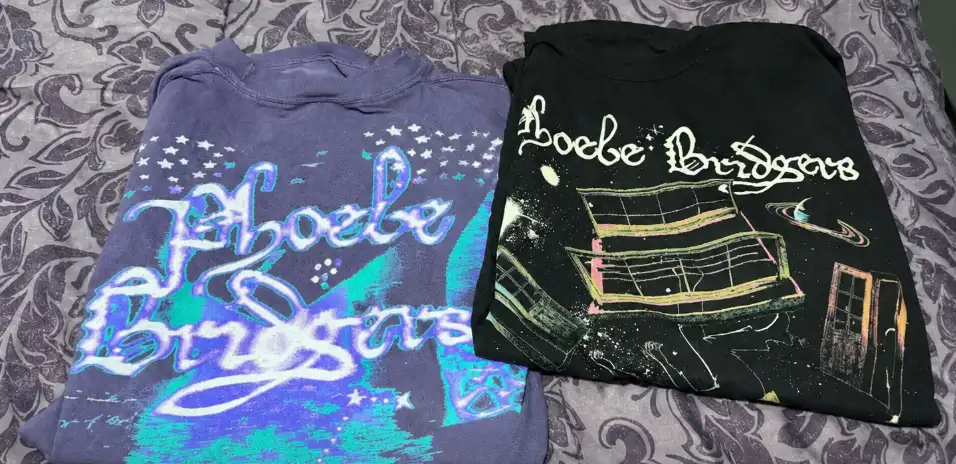
The gray tour tee with the dates was noticeably softer and more oversized than the purple Phoebe design I bought. Both are quite long, but if you want a more fitted look in the gray tour shirt, I would consider sizing down. The purple tee fits smaller and isn't quite as soft, so I would size up if you're looking for an oversized fit.
The purple design was still my favorite visually, with teal and purple psychedelic/celestial graphics, conveniently also two of my favorite colors.
Wearing your concert merch the night after a show is a badge of honor for any concert lover. But much to my surprise, as I was tucking myself into bed, I noticed a soft glow emanating from under the covers. My gray concert shirt was glowing in the dark.
Alex G also had his own merch available, including shirts and a sweatshirt.
If buying merch is important to you, I would either arrive close to doors or accept that you may sacrifice part of the opener. Waiting until right before Phoebe goes on is risky.
Is there a Phoebe Bridgers photo booth?
At Barclays, yes.
A branded photo booth was stationed near Section 19. It took three photos and printed two traditional strips, with an option to shoot in color or black-and-white. You could also email a digital copy to yourself, and the strip included Phoebe Bridgers tour branding at the bottom.
The catch was the line.
People waited for hours, and some fans started leaving the seating bowl before the end of the concert to squeeze in photos before the booth closed. I went with roughly two songs remaining and made it through, but the booth shut down as soon as the concert ended.
Merch remained open afterward.
If a photo booth matters to you, don't assume you'll be able to casually stop by on the way out.
Where should you sit for Phoebe Bridgers?
I sat in Section 22, Row 10, Seat 7, directly on the aisle. The location was excellent.
The B-stage was directly in front of me, but what surprised me most was how much I appreciated having a fairly complete view of the main-stage production.
I normally like side-stage tickets because you can often find them for substantially less close to showtime. The tradeoff is that you sometimes lose the full visual production.
For this tour, I would prioritize seeing the whole stage.
The projected curtains, UFO structure, celestial graphics and lighting are a large part of the experience, so a seat with a more direct view has real value.
That said, I noticed that even the sections at the very back of Barclays appeared to retain clear sightlines despite the B-stage and lighting structures.
And there is one unusual factor when choosing seats for a completely phone-free show: your view isn't competing with your ability to capture it.
Normally I care more about proximity because I want good photos and video. At this concert, I couldn't take either. Sitting farther away and simply absorbing the overall production suddenly didn't feel like as much of a compromise. Thus, seats at the top of the arena would work well too.
What should I bring to Phoebe Bridgers?
The item I wish I'd thought about beforehand is almost comically simple: a watch.
Not an Apple Watch. Not another smart device. Just something that tells time.
I'd also bring a physical credit/debit card, keep electronics to an absolute minimum and consider throwing a small notebook into your bag.
A notebook isn't essential, but without a phone, it gives you somewhere to jot down something you want to remember. I was covering the show professionally, but I actually liked having to physically write down little observations rather than immediately typing them into Google Keep.
Most importantly, don't expect to sneak around the policy. I did not see a single audience member openly filming during the entire performance, and Barclays explicitly states that anyone caught using a prohibited device can be removed (although it is worth noting that employees did have access to their phones).
Is Phoebe Bridgers’ Lost Tour worth seeing live?
I walked into Barclays knowing zero Phoebe Bridgers songs.
I also walked in convinced the phone policy might make me miserable.
Neither mattered.
Her voice sounded beautiful live, moving from delicate, almost angelic vocals to full screams without losing clarity. The production was bizarre, celestial and beautiful. The songs were sad without making the night feel draining. At several points, I found myself crying even though I had no existing attachment to the music.
It felt cathartic.
But what has stayed with me most is the thing I expected to dislike.
During the final stretch of the show, thousands of people were singing, dancing and waving their arms from side to side. Normally that scene would be punctuated by thousands of illuminated rectangles hovering above everyone’s heads.
There weren't any.
From where I was sitting, the crowd looked almost like an ocean moving together.
And there's something inherently temporary about that. I can explain what it looked like. Phoebe's professional photographers captured parts of the night. I can tell you what songs she played and what happened onstage.
But I can't show you exactly what it felt like to be in that room.
For once, neither could anybody else in the audience.
That's what made it special.
📁 Categories: Front Row, Concerts
🏷️ Tags: Phoebe Bridgers, The Lost Tour, Alex G, Barclays Center, Brooklyn